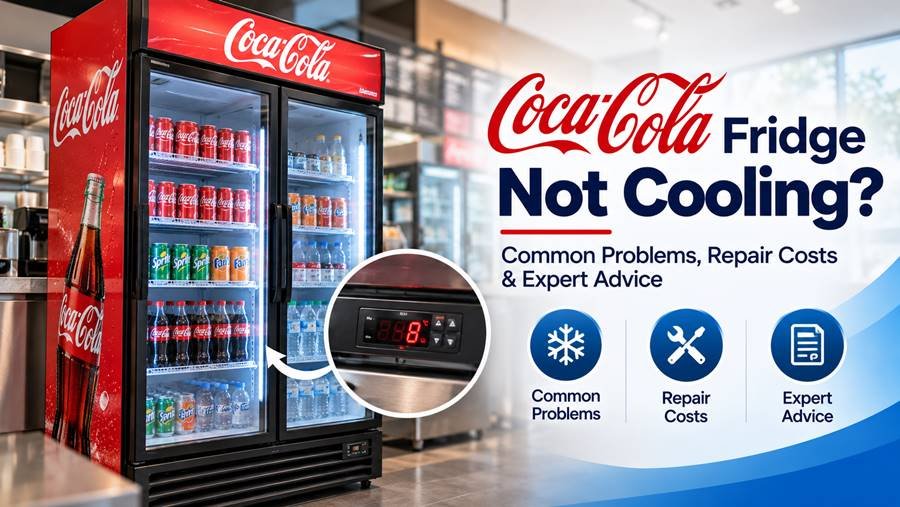
A Coca-Cola display fridge that stops chilling drinks can disrupt service, but the logo on the door does not identify the refrigeration equipment inside. Before arranging repairs, find the manufacturer’s label and confirm who owns the cabinet.
The problem could involve airflow, door closure, temperature controls or refrigeration components. A proper diagnosis helps establish what needs attention and whether repair is practical.
This guide explains the checks you can make, the faults a technician investigates and how to approach repair costs.
First, Check Who Owns the Fridge
A branded cooler may belong to your business, a supplier or another equipment provider. Check your purchase paperwork, supply agreement and any asset sticker before authorising paid repairs.
Coca-Cola Europacific Partners reports ownership of cold-drink equipment, including coolers and vending machines. That does not establish who owns your particular fridge or what service arrangements apply.
If the cabinet was supplied through your drinks account, ask the provider who should arrange the assessment. Confirm any approval requirements before booking an independent technician.
For an outright purchase, check the seller’s warranty and available service documentation.
Identify the Equipment Behind the Branding
Photograph the rating plate, usually found inside the cabinet or on an external label. Record:
- Manufacturer and model number.
- Serial number.
- Refrigerant type shown on the label.
- Asset number, if fitted.
- Controller display and any warning.
- The whole cabinet and its installation.
Provide these details when enquiring about beverage fridge repairs. They help identify the correct documentation, components and service suitability.
Avoid ordering a thermostat or controller based only on the fridge’s appearance.
Common Coca-Cola Display Fridge Faults
The following symptoms guide an inspection; they do not confirm which part has failed.
| Symptom | Possible Areas to Investigate |
|---|---|
| Lights work, but drinks remain warm | Controls, compressor operation, fans and refrigeration performance. |
| Cooling differs between shelves | Stock obstructing air paths, fan operation or ice restriction. |
| Cabinet runs for unusually long periods | Door sealing, ventilation, condenser condition and cooling performance. |
| Frost repeatedly returns | Air entering the cabinet, airflow restrictions or defrost components. |
| Water pools beneath the fridge | Drainage, collection tray and condensation. |
| Door will not close properly | Stock position, hinges, closer and gasket contact. |
Bromic’s commercial refrigeration guidance identifies door gaskets, condensers, filters and drainage as important maintenance areas. Exact checks and access procedures depend on the manufacturer and model.
The Fridge Is Running but Not Cooling
An audible motor or illuminated cabinet does not prove that refrigeration is working correctly.
A technician checks which components are operating, whether the cabinet is producing cooling and how air moves through the storage area. Lowering the setting repeatedly will not correct a failed component.
Drinks Are Warm After Restocking
Loading warm drinks adds a cooling demand. However, slow recovery can also involve obstructed circulation or a developing fault.
Check whether stock blocks vents or exceeds the loading instructions. If recovery has become noticeably worse under similar conditions, arrange an assessment rather than assuming the cabinet simply needs more time.
The Controller Shows an Error
Photograph the complete code. Its meaning depends on the controller and equipment configuration.
A warning can relate to a probe, wiring, controlled component or the controller itself. Replacing the display without testing the connected system can leave the original fault unresolved.
Safe Checks Before Booking Repairs
Start with the checks permitted in the owner’s manual:
- Confirm the fridge is switched on and connected correctly.
- Check that bottles, shelves or packaging do not obstruct the door.
- Inspect the gasket for dirt, gaps or damage.
- Keep internal air passages and external ventilation openings clear.
- Record the selected setting and any warning.
- Note recent restocking, relocation or changes around the cabinet.
Clean accessible areas only as instructed, with the appliance unplugged. Leave electrical and refrigeration access to the appropriate service personnel.
For example, Frigoglass’s ICOOL manual reserves access to cooling-system and electrical components for authorised service personnel. It also gives model-specific cleaning and maintenance instructions.
Do not puncture ice, bypass a controller or attempt a refrigerant top-up yourself.
How Much Does Display Fridge Repair Cost in Australia?
The cost depends on the actual equipment, fault, parts availability, location and appointment time. There is no reliable fixed price for every Coca-Cola-branded cooler.
As an indicative reference, an Australian commercial refrigeration supplier publishes the following guide:
| Charge or Repair | Published Indicative Range |
|---|---|
| Call-out fee | \$100–\$250 |
| Labour | \$90–\$160 per hour |
| Compressor replacement, including labour | \$600–\$2,500 |
These figures come from Adgemis Refrigeration’s published cost guide. They are general guidance, not Master Fridge Repairs’ prices or a quote for your cabinet. Confirm GST treatment, inclusions and any after-hours charges.
Questions to Ask the Repairer:
- What does the attendance or assessment fee include?
- Are parts and repair labour additional?
- Does a return visit attract another charge?
- Will approval be requested before additional work?
- What warranty applies to supplied parts and completed work?
A low advertised call-out fee may represent only part of the bill. Compare the total proposed work and inclusions. Master Fridge Repairs offers free phone quotes, with further quoting based on the equipment and diagnostic findings.
When Should You Call a Technician?
Cooling Does Not Recover
Arrange an assessment if the cabinet remains too warm despite correct settings, unobstructed airflow and proper door closure.
Share when the problem started and whether it affects the entire cabinet or particular shelves.
Frost, Leaks or Alarms Keep Returning
A fault that temporarily disappears after restarting or defrosting still needs investigation if it returns. Describe the pattern and preserve photographs before conditions change.
The Fridge Clicks Repeatedly or Makes a New Scraping Noise
Repeated unsuccessful starts or fan interference warrant checks. The sound helps guide diagnosis, but it does not automatically establish a compressor failure.
Electrical Warning Signs
Stop using the cabinet if it produces a burning smell, sparks, repeatedly trips electrical protection or leaks water onto electrical components. Isolate power if safe and arrange professional assistance.
Should You Repair or Replace the Cabinet?
First establish ownership and any supplier replacement options. For business-owned equipment, compare the repair quote with the cost of a suitable replacement.
Consider:
- Overall cabinet and door condition.
- Parts availability.
- Previous breakdowns.
- The scope of the current fault.
- Whether the equipment suits its installation and workload.
- Delivery, installation and removal costs for a replacement.
Age alone does not settle the decision. A repairable component fault and extensive cabinet deterioration present different choices.
Also check the cabinet’s intended use. A drinks merchandiser is not automatically suitable for storing perishable food. The Frigoglass ICOOL manual, for example, specifically excludes food storage for the models it covers. Follow your equipment’s instructions.
Need Display Fridge Repair Advice in Sydney?
Master Fridge Repairs provides commercial refrigeration repairs and glass-door fridge repairs across Sydney.
Before enquiring, confirm ownership and send photographs of the manufacturer’s label, asset sticker and controller. We can discuss the symptoms and confirm service suitability.
Have your equipment make, model, asset number and controller photos ready.