
Fridge Regas, Freezer Regas & Cold Room Regas in Sydney
Losing cooling power? Book a licensed Sydney technician for same-day fridge, freezer and coolroom regassing — leak found, leak fixed, gas recharged, performance verified.
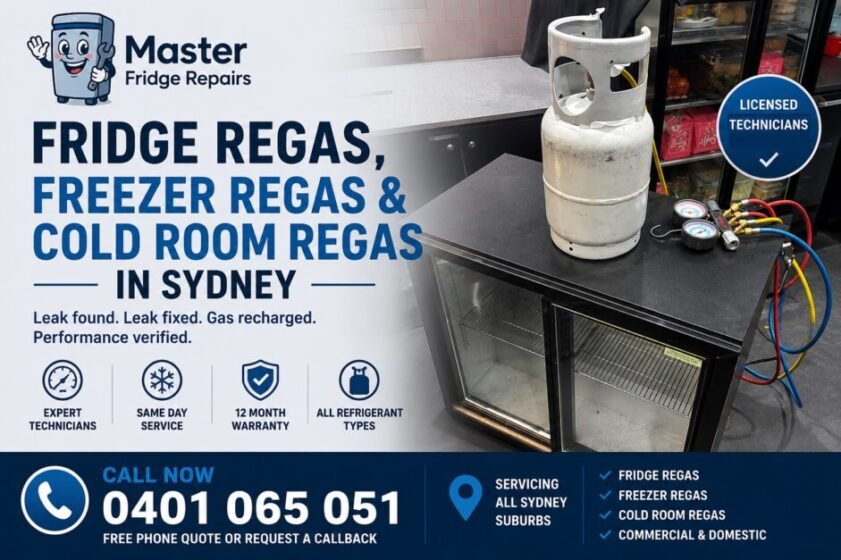
What is fridge and freezer regassing?
Regassing is the process of recovering the old refrigerant from a sealed cooling system, repairing whatever caused the loss, drawing the system down to a deep vacuum, and recharging it with the correct type and exact weight of refrigerant — then testing that it cools properly. It is often called a "regas," a "refrigerant recharge," or "topping up the gas."
A refrigerator, freezer or coolroom is a sealed system. Unlike a car tyre, it isn't designed to slowly lose gas and be topped up on a schedule. If the refrigerant charge has dropped, it's because refrigerant has escaped somewhere — and that leak has to be found and fixed before new gas goes in. Adding refrigerant to a leaking system simply vents expensive, high-impact gas into the atmosphere and leaves you back where you started within days.
At Master Fridge Repairs, every regas we perform is done properly: diagnose, repair, evacuate, recharge, verify. We're a mobile, licensed refrigeration team covering all of Sydney, backed by 20+ years in the trade and a 12-month warranty on parts and workmanship.
Does your fridge actually need a regas?
This is the honest answer most repairers won't give you — and it's why customers trust us.
Most domestic fridges never need regassing. A household fridge or freezer holds only a small refrigerant charge (commonly R134a or R600a). If that charge leaks, the appliance stops cooling fast — usually within hours to a day or two, not gradually over months or years. A sealed system doesn't "wear down" and lose gas slowly; it either holds its charge or it has a physical leak.
So when a fridge stops getting cold, low gas is often not the real cause. Far more common culprits include:
- A faulty thermostat or temperature control board
- Dirty or blocked condenser coils (dust choking the heat exchange)
- A failed evaporator or condenser fan motor
- A defrost system fault (heater, timer or sensor) causing ice build-up
- Worn or torn door seals (gaskets) letting warm air in
- A blocked capillary tube or filter drier restricting refrigerant flow
- A tired compressor that's running but no longer pumping efficiently
A genuine regas is only worthwhile once a licensed technician has connected gauges, read the system pressures, and confirmed the fault is refrigerant loss — and then located and repaired the leak. That's exactly how we work. We won't sell you gas you don't need, and if a repair isn't economical, we'll tell you honestly whether a new unit is the smarter spend.
Where regassing genuinely matters: commercial refrigeration, coolrooms and freezer rooms, display cabinets and larger split-condenser systems. These carry bigger charges, run harder, have more jointed pipework, and are far more prone to developing real refrigerant leaks that need professional repair and recharge.
Signs your fridge, freezer or coolroom may have a refrigerant fault
Call us for a diagnosis if you notice:
- The unit runs constantly but won't get cold, or only the freezer works
- Warm spots or uneven cooling inside the cabinet or coolroom
- The compressor is running hot and never cycles off
- A sudden jump in your energy bill with no other explanation
- Hissing or bubbling sounds from the pipework
- Oily residue or stains near the coils, joints or compressor (a classic leak sign)
- Unusual ice or frost build-up on the evaporator or coolroom coil
- A chemical or faint sweet smell near the back of the unit
Any of these can point to low refrigerant — but they can equally point to a mechanical fault. Our job is to tell the difference correctly the first time.
Our fridge & coolroom regas process, step by step
We follow correct refrigeration practice on every job — no shortcuts, no "just add gas."
Diagnose and confirm
We connect manifold gauges, read high- and low-side pressures, and verify whether the fault is genuinely a low charge or a mechanical issue.
Locate the leak
Using electronic leak detectors, UV dye or a dry-nitrogen pressure test, we find exactly where refrigerant is escaping.
Repair it
We braze or replace the affected pipework, fittings or components, and replace the filter drier to protect the system.
Recover old refrigerant
Any remaining gas is recovered into a proper recovery cylinder — never vented to atmosphere, as required by law.
Evacuate the system
We pull a deep vacuum to remove all air and moisture, which otherwise cause acid formation, blockages and compressor failure.
Recharge accurately
We charge the exact refrigerant type and weight specified for your unit — measured, not guessed.
Test and verify
We check operating pressures, superheat/subcooling and pull-down temperatures to confirm the system is cooling efficiently before we leave.
Refrigerant types we handle
Our technicians are trained and licensed across the full range of refrigerants used in Australian fridges, freezers and commercial systems:
| Application | Common refrigerants | Notes |
|---|---|---|
| Domestic fridges & freezers | R600a (isobutane), R134a | R600a is a hydrocarbon and mildly flammable — correct handling is essential |
| Older domestic units | R12, R22 | Legacy gases; often the point at which replacement makes more sense |
| Commercial fridges & coolrooms | R404A, R507A, R134a | R404A is being phased down (see below) |
| Low-GWP replacements | R448A, R449A, R452A | Lower-impact retrofits for existing R404A systems |
| Newer & natural refrigerants | R32, R290 (propane), R744 (CO₂) | Increasingly standard in new equipment |
Because refrigerants like R290, R600a and R32 are flammable, and because handling any fluorocarbon gas is legally restricted, this is not DIY work. Using the wrong gas — or the wrong charge weight — can wreck a compressor or create a genuine safety hazard.
Coolroom, cold room & freezer room regas
For cafés, restaurants, butchers, florists, supermarkets and cold-storage operators, a coolroom losing temperature means stock at risk and lost trade. We provide fast, on-site coolroom and freezer room regassing across Sydney, including leak detection and repair for walk-in units.
We also help businesses navigate the R404A phase-down. R404A has one of the highest global warming potentials of any common refrigerant, and Australia's HFC import quota is shrinking under the Kigali Amendment — pushing R404A prices up and availability down. If your coolroom still runs on R404A, we can retrofit it to a lower-GWP alternative such as R448A or R449A, or advise on future-proofing your system.
Why choose Master Fridge Repairs?
- 20+ years repairing Sydney fridges, freezers and coolrooms
- Same-day service across the Sydney metro area
- Licensed technicians and fully insured
- 12-month warranty on parts and workmanship
- Fully mobile — we come to your home or business
- Genuine spare parts and correct-spec refrigerants
- Honest advice — we'll tell you when a regas isn't the answer
- Senior citizen discount available
Whatever's gone wrong with your fridge, Master Fridge Repairs' expert refrigerator mechanics have the solution.
Areas we serve
We provide fridge, freezer and coolroom regassing right across Sydney — the CBD, Eastern Suburbs, Northern Beaches, North Shore, Inner West, South West, Greater Western Sydney and the Sutherland Shire. See our full service area list or simply call to confirm we cover your suburb.
Brands we regas and repair
We service refrigerators and commercial units from every major brand, including:
See the full list on our Brands We Repair page.
Frequently asked questions
Can you regas a domestic fridge?
Yes — but often you shouldn't need to. Domestic fridges are sealed systems with a small refrigerant charge, so if they lose gas it's due to a physical leak, and a leak in a household unit shows up within hours or days rather than gradually. We'll diagnose the real cause first. If it genuinely is a leak, we repair it and recharge the system; if the fault is a thermostat, fan, coil or seal, we fix that instead and save you money.
How do I know if my fridge has lost gas?
The tell-tale signs are a unit that runs non-stop but won't get cold, warm spots inside, a compressor that never cycles off, higher power bills, hissing sounds, or oily residue near the pipework. However, these symptoms overlap with mechanical faults, so the only reliable way to confirm low refrigerant is for a licensed technician to read the system pressures with gauges.
How much does a fridge or coolroom regas cost in Sydney?
It depends on the type of unit, the refrigerant it uses, and whether a leak needs repairing — a small domestic recharge is very different from a walk-in coolroom leak repair and recharge. Because pricing varies, we give a free, no-obligation quote over the phone. Call 0401 065 051 and we'll give you a clear estimate before any work begins.
Is it worth regassing an old fridge, or should I replace it?
If the appliance is more than about 10–12 years old and needs a leak repair plus a recharge, replacement is often the better value — a genuine sealed-system leak in an older unit usually means the pipework is corroding. We'll give you an honest recommendation based on the unit's age, the fault, and the repair cost versus a new one.
How long does a regas take?
A straightforward domestic recharge after a minor repair can often be completed in a single same-day visit. Coolroom and commercial jobs that involve leak detection, brazing, evacuation and a full recharge take longer, but we always aim to restore cooling as quickly as possible to protect your stock.
Do you need a licence to regas a fridge in Australia?
Yes. Handling fluorocarbon refrigerants legally requires a Refrigerant Handling Licence (ARCtick) from the Australian Refrigeration Council, and it's a strict-liability offence to handle these gases without one. Our technicians are licensed and our business holds a Refrigerant Trading Authorisation, so every regas is done legally and the old gas is recovered rather than released.
What refrigerant does my fridge use?
Most modern domestic fridges use R600a (isobutane) or R134a; older units may use R12 or R22. Commercial fridges and coolrooms commonly use R404A, R134a or R507A, with newer systems moving to R448A, R449A, R32 or natural refrigerants like R290 and CO₂. The data plate on your unit lists the exact refrigerant and charge — and our technicians carry the correct gases for all of them.
Can you regas a coolroom on-site?
Yes. Our service is fully mobile, and we carry out coolroom and freezer room leak detection, repair and recharging on your premises across Sydney, so your business doesn't have to move or shut down the unit.
Is R404A being phased out?
R404A is being phased down in Australia under the national HFC phase-down and the international Kigali Amendment because of its very high global warming potential. Import quotas are shrinking, which is pushing prices up. Existing systems can keep running for now, but we can retrofit R404A coolrooms to lower-impact alternatives like R448A or R449A and help you plan ahead.
How often does a fridge need regassing?
A healthy sealed system should never need routine regassing — there's no scheduled "top-up." If your fridge or coolroom is losing gas repeatedly, that's a sign of an unrepaired leak, and the leak itself needs fixing rather than the system being refilled again and again.
Book your fridge, freezer or coolroom regas today
Don't lose your food or your stock to a fridge that won't cool. Our licensed Sydney technicians will diagnose the real problem, fix it properly, and get you back to temperature — usually the same day.