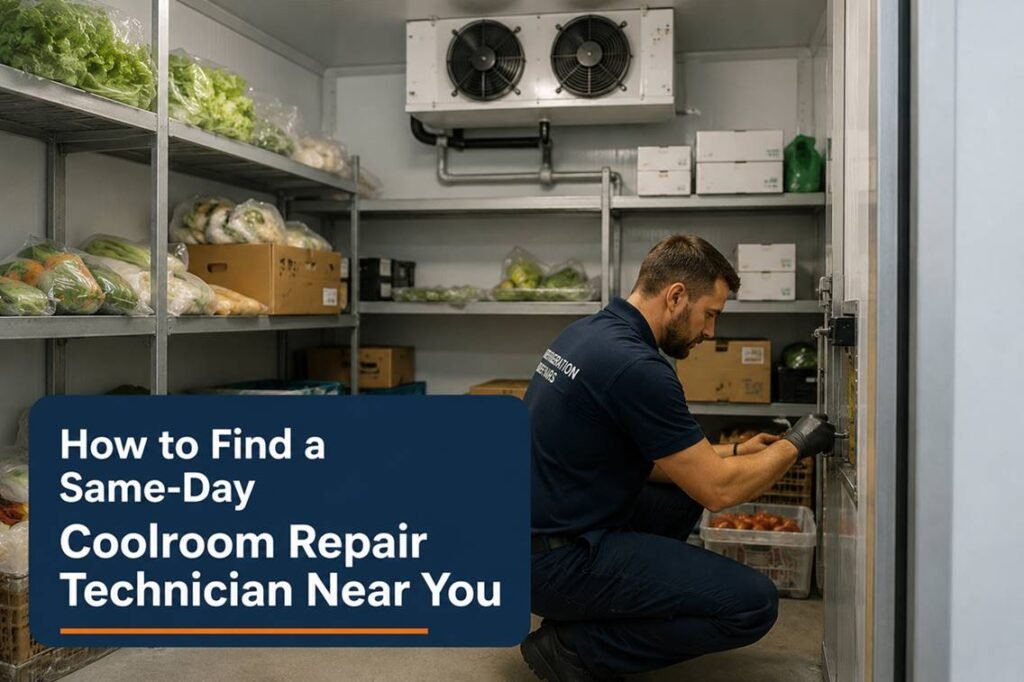
A coolroom that suddenly stops holding temperature can quickly become a serious problem for a restaurant, cafe, butcher, supermarket, commercial kitchen or any business storing temperature-sensitive products. When stock is at risk, you need more than someone who can simply arrive quickly. You need a refrigeration technician who can diagnose the system properly and explain what needs to be repaired.
If you are looking for a same day coolroom repair technician near you, check that they have genuine commercial refrigeration experience, appropriate licensing for the work involved, a proper diagnostic process and realistic availability in your area.
Same-day service can be valuable during an urgent breakdown, but speed should not come at the expense of correct diagnosis.
What Should You Look for in a Same-Day Coolroom Technician?
A reliable coolroom technician should be able to do more than reset a controller or add refrigerant. Before booking, look for:
- experience repairing commercial coolrooms
- knowledge of commercial refrigeration systems
- appropriate refrigerant handling licensing
- a structured fault-finding process
- genuine customer reviews
- clear communication about the fault and repair options
- emergency or after-hours availability where required
- realistic same-day availability rather than guaranteed arrival claims
- experience with the type of coolroom or refrigeration equipment at your business
The right technician should investigate why the coolroom has stopped maintaining temperature instead of automatically assuming that one component has failed.
1. Choose Someone Who Regularly Repairs Commercial Coolrooms
A commercial coolroom is not simply an oversized domestic refrigerator. Depending on the design, the refrigeration system may include a separate evaporator and condensing unit, temperature controller, probes, fan motors, defrost controls, refrigerant pipework and electrical components.
A technician diagnosing a coolroom may need to check:
- compressor operation
- condenser condition
- condenser fan motor
- evaporator coil
- evaporator fan motors
- temperature sensors or probes
- thermostat or electronic controller
- defrost heaters
- defrost sensors
- electrical controls
- contactors and start components
- filter drier
- expansion valve or capillary system
- refrigerant circuit
- door seals
- drainage
- room airflow
This matters because several different faults can produce the same symptom. For example, a coolroom sitting above its normal temperature does not automatically mean the compressor has failed. Restricted airflow, a frozen evaporator, dirty condenser, faulty fan, incorrect sensor reading, defrost problem or refrigeration-circuit fault can all affect cooling.
When speaking with a company, ask whether they regularly work on commercial coolrooms and refrigeration systems rather than relying only on general appliance repair experience.
2. Check Refrigerant Handling Licensing
Licensing becomes particularly important when work involves regulated refrigerants or the sealed refrigeration system.
The Australian Refrigeration Council states that a Refrigerant Handling Licence is required for people carrying out work on refrigeration and air-conditioning equipment involving fluorocarbon refrigerants, including work that creates a risk of refrigerant being emitted.
That can include activities associated with servicing, maintaining, commissioning and decommissioning refrigeration equipment.
Master Fridge Repairs identifies itself as ARCtick licensed and works on domestic and commercial refrigeration systems across Sydney.
If your coolroom repair involves refrigerant, compressors, leak testing or other sealed-system work, appropriate refrigeration licensing should be one of the things you check before going ahead.
3. Ask Whether Same-Day Service Is Actually Available in Your Area
"Same-day" can mean different things depending on the refrigeration company, technician workload, location and time of the call.
A better question than simply asking, "Do you offer same-day repairs?" is: "Can a coolroom technician reach my suburb today?"
Give the company:
- your suburb
- type of coolroom
- current temperature
- normal set temperature
- description of the fault
- when the problem started
- any controller alarm or error code
This allows them to give you a more realistic answer.
Master Fridge Repairs offers same-day appointments for many refrigeration jobs where scheduling allows. If your coolroom has failed, call 0401 065 051 and explain the fault and location so current availability can be confirmed.
Avoid companies that guarantee an unrealistic response time without first knowing where you are or what the job involves.
4. Look for Diagnosis Before Parts Are Replaced
Correct coolroom repair starts with finding the cause. A warm coolroom can have multiple possible faults, so an experienced technician may need to work through the system logically.
Check temperature controls
The technician may compare the controller set point with the displayed temperature and actual room temperature. A faulty temperature probe can tell the controller that the room is colder or warmer than it really is. Controller faults can also interfere with compressor, fan or defrost operation.
Check evaporator airflow
The evaporator absorbs heat from inside the coolroom. If air cannot pass through it properly, refrigeration performance can drop even while other parts of the system continue operating. Causes include evaporator ice build-up, blocked coil, failed fan motor, damaged fan blade, product obstructing airflow, or return-air blockage.
Inspect the condenser
The condenser needs to reject heat from the refrigeration system. A dirty condenser or failed condenser fan can reduce heat transfer and increase stress on the refrigeration equipment. Commercial environments can expose condensers to dust, grease and other contaminants, making condenser condition an important part of fault diagnosis.
Check defrost operation
Excessive ice across the evaporator can restrict airflow and eventually stop the coolroom from reaching temperature. Causes include failed defrost heaters, faulty sensors, controller issues, incorrect defrost settings, fan problems, moisture entering through damaged door seals, or refrigeration-system faults. Simply melting the ice may restore cooling temporarily, but it does not fix the cause of the icing.
5. Be Careful When Someone Says the Coolroom "Just Needs Gas"
One of the most important questions to ask is why refrigerant is believed to be low. Refrigerant operates inside a sealed refrigeration circuit. It is not normally consumed during everyday cooling. If refrigerant has been lost, the reason should be investigated.
Current Australian Refrigerant Handling Code guidance says leaks should be fixed before a system is recharged, rather than repeatedly adding refrigerant to a known leaking system.
Depending on the fault, proper sealed-system work may involve:
- diagnosing the refrigeration problem
- assessing the system for refrigerant loss
- identifying the source of a leak where practical
- carrying out the appropriate repair
- pressure or leak testing where required
- evacuating the refrigeration circuit
- charging the correct refrigerant
- testing operation and cooling performance
A coolroom that is not cooling does not automatically need refrigerant. Poor airflow, evaporator icing, fan problems, sensors, electronic controls, condenser faults and compressor problems can create similar symptoms.
For refrigeration-circuit problems, Master Fridge Repairs also has dedicated fridge, freezer and coolroom regas services.
6. Find Out Whether the Technician Can Explain the Fault
You do not need refrigeration training to ask for a sensible explanation. After inspecting the coolroom, a technician should generally be able to explain:
- what symptom was confirmed
- what was tested
- what fault was found
- what may have caused it
- what repair is recommended
- whether further diagnosis is required
- whether repair or replacement makes more sense
Sometimes a technician cannot give a final answer immediately because more testing is genuinely required. That is different from replacing components by guesswork.
Be cautious when an expensive repair is recommended but there is no explanation of how the conclusion was reached.
7. Read Genuine Reviews, Not Just the Star Rating
Reviews are useful when you read what customers actually say. Look for reviews that describe coolroom repairs, commercial refrigeration, urgent breakdowns, communication, diagnosis, punctuality, repair outcomes, professionalism, and repeat service.
A detailed review describing the equipment and problem can often tell you more than dozens of one-line ratings.
Master Fridge Repairs currently displays customer feedback on its website, including reviews relating to coolroom and freezer-room breakdowns. Where possible, check the company's genuine Google Business Profile as well.
8. Understand How Quotes Work for Coolroom Repairs
It is not always possible to determine the exact cost of a refrigeration fault from a phone call. Several different components can cause similar symptoms.
For example, "coolroom running but warm" could potentially involve fan motors, airflow, defrost system, condenser, controller, temperature probe, compressor, or the refrigerant circuit. A technician may therefore need to diagnose the equipment before the full repair scope becomes clear.
Master Fridge Repairs offers free quotes over the phone. Depending on the repair and circumstances, further quotes may be provided verbally or in writing. Before approving work, ask what was found and what repair is being recommended.
Price is important, but choosing the lowest figure without understanding what is actually being repaired can create a more expensive problem later.
9. Know When a Coolroom Breakdown Needs Urgent Attention
Some coolroom faults give warning before the system stops completely. Arrange diagnosis promptly if you notice:
- room temperature steadily increasing
- refrigeration system running continuously
- evaporator covered in heavy ice
- evaporator fans not operating
- condenser fan stopped
- unusual compressor noise
- controller alarms
- repeated circuit trips
- water leaking around the coolroom
- temperature repeatedly moving outside its normal range
- system restarting but failing again shortly afterwards
Urgency becomes particularly important when the room contains food or other temperature-sensitive stock.
10. What Should You Do While Waiting for a Coolroom Technician?
If the temperature is rising, your first priority should be protecting the stock and avoiding unnecessary additional heat entering the room. You can:
- check the displayed coolroom temperature
- check product temperature using an appropriate thermometer where required
- note when the temperature problem began
- keep doors closed as much as practical
- avoid repeatedly opening the room to check whether it feels cold
- avoid loading warm product into a struggling coolroom
- record controller alarms or error codes
- take a photo of the controller display
- follow your business's food-safety procedures
- arrange refrigeration diagnosis promptly
Do not dismantle electrical components or open the sealed refrigeration system yourself.
Food Businesses Should Take Rising Temperatures Seriously
For Sydney cafes, restaurants, butchers, supermarkets and commercial kitchens, a refrigeration failure can become a food-safety issue as well as an equipment problem. The NSW Food Authority states that potentially hazardous cold foods generally need to be kept at 5°C or below. It also requires businesses handling potentially hazardous food to have access to an accurate probe-type thermometer.
The NSW Food Authority also applies the 2-hour/4-hour rule for potentially hazardous food held between 5°C and 60°C:
Importantly, the time is cumulative. A refrigeration technician diagnoses and repairs the equipment. Decisions about potentially unsafe food should follow your food-safety procedures and current NSW Food Authority requirements.
11. Ask About Emergency and After-Hours Refrigeration Repairs
Coolrooms can fail outside standard business hours. Restaurants may discover a problem after dinner service. A bakery may notice rising temperatures early in the morning. A commercial kitchen may have refrigeration fail before a weekend.
If the stock cannot safely wait until the next normal service period, ask about emergency or after-hours repair availability.
When calling, explain:
- where the business is located
- what the room is storing
- current temperature
- usual set point
- whether the system appears to be running
- any alarms or unusual noises
- when the fault started
Master Fridge Repairs offers emergency and after-hours refrigeration support and asks customers to call so actual availability can be confirmed.
12. Have the Right Information Ready Before You Call
Giving the technician useful information before the visit can make the booking process easier. If possible, have the following ready:
- business name
- suburb
- coolroom or freezer-room type
- current temperature
- normal set temperature
- controller brand
- error or alarm code
- when the fault started
- whether the room is still cooling at all
- whether fans are operating
- whether there is visible ice
- unusual noises or recent repair history
Equipment photos can also help. A photo of the controller, evaporator, condensing unit or equipment data plate may provide useful information before the technician arrives.
13. Watch for These Coolroom Repair Red Flags
Speed matters during an urgent breakdown, but there are still warning signs worth watching for.
Ask more questions if a technician:
- diagnoses a major fault without testing the equipment
- says every warm coolroom needs refrigerant
- repeatedly adds refrigerant to a known leaking system without addressing the leak
- cannot explain what was tested
- recommends replacing an expensive component without explaining why
- has little experience with commercial refrigeration
- cannot provide clear business details
- makes unrealistic guarantees about arrival or repair time
- recommends complete system replacement without explaining why repair is not practical
A technician saying, "I need to test that before I can confirm it," can be a much better sign than someone giving a confident diagnosis without evidence.
14. Should You Repair or Replace the Coolroom Refrigeration System?
Most coolroom faults do not automatically justify replacing the entire system. Problems involving components such as fan motors, temperature sensors, electronic controllers, defrost components, electrical controls, door seals, and drainage may be repairable depending on the condition of the equipment.
Even compressor or refrigeration-circuit faults need to be considered in context. Replacement may become more practical when there is a combination of:
- repeated major failures
- extensive system deterioration
- serious refrigerant leaks
- significant compressor problems
- limited parts availability
- ongoing temperature-control problems
- high repair cost relative to the condition of the equipment
There is no universal age at which every coolroom refrigeration system should be replaced. A technician should assess the actual fault and condition of the equipment rather than relying only on age.
15. Preventative Maintenance Can Help Identify Developing Problems
Maintenance cannot guarantee that a coolroom will never break down, but it can help identify deterioration before it develops into a larger fault. The appropriate maintenance schedule depends on factors such as equipment design, operating hours, manufacturer recommendations, condenser environment, grease and dust exposure, door traffic, stock loading, and previous repair history.
Typical areas that may be checked include:
- condenser cleanliness
- evaporator condition
- fan operation
- door seals
- drainage
- controller performance
- temperature probes
- unusual frost formation
- electrical components
- signs of refrigerant leakage
A busy restaurant coolroom exposed to heat and grease may require different attention from a lightly used coolroom in a cleaner environment.
Finding a Same-Day Coolroom Technician Near You in Sydney
When your coolroom has stopped maintaining temperature, focus on both speed and technical capability. The technician should understand commercial refrigeration, follow the correct diagnostic process and be able to explain what has failed before recommending the repair.
Master Fridge Repairs has more than 20 years of refrigeration experience and covers 600+ locations across Sydney.
If you need a same-day coolroom technician near you, call 0401 065 051. Tell us your suburb, current coolroom temperature and what the system is doing. We can confirm current availability and discuss the next step.
Free quotes are available over the phone. Depending on the repair, further quotes may be provided verbally or in writing.
Frequently Asked Questions
Need a Coolroom Technician in Sydney Today?
If your coolroom is warming up, icing over, showing an alarm or failing to maintain temperature, call Master Fridge Repairs.