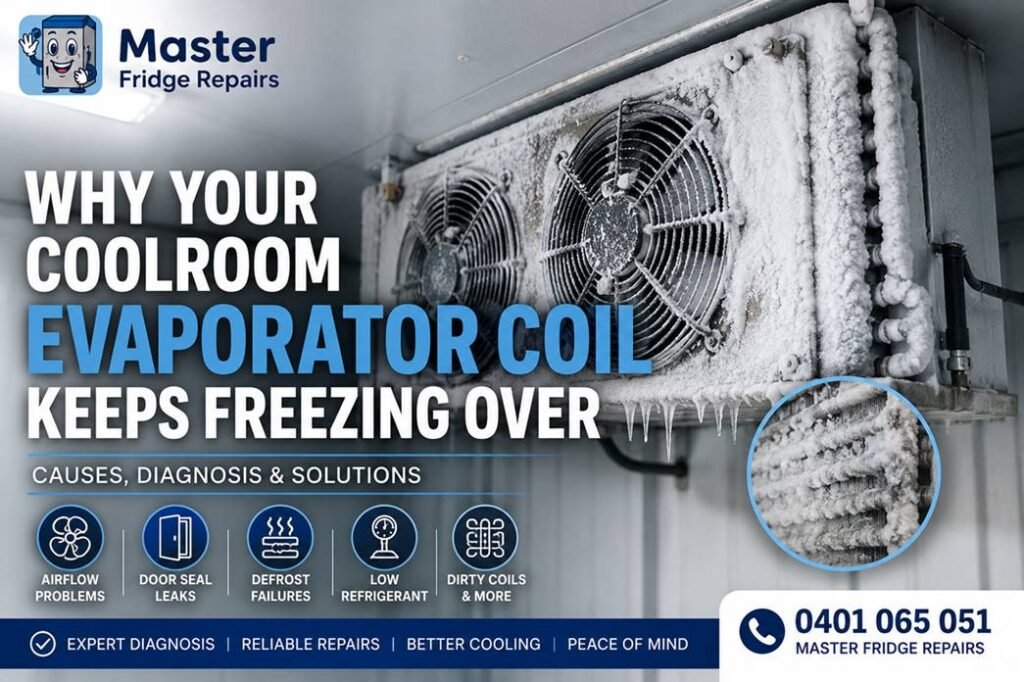
If you have opened your coolroom this morning and found the evaporator buried under a slab of ice, you are not looking at a cosmetic problem. You are looking at a symptom.
The evaporator coil is the part of your coolroom that actually does the cooling. Refrigerant boils inside its tubes at a temperature well below the room air, the evaporator fans push return air across the fins, and heat moves out of the room and into the refrigerant.
A light, even frost across the fins is normal. Coolroom coils sit below 0°C for much of their cycle, so airborne moisture inevitably freezes onto them. That frost is meant to be cleared by the defrost cycle every few hours.
Thick ice is a different story. When ice bridges the fins, blocks the coil face or builds up around the fan housings, something has failed — and the ice will keep coming back until that fault is found. Businesses that keep steaming the coil clear usually pay twice: once for stock, and again for a compressor.
How a Coolroom Evaporator Works
Liquid refrigerant is metered into the evaporator through an expansion valve (TXV). The pressure drop lets it boil at a low temperature, typically several degrees below your target room temperature, and as it boils it absorbs heat.
The evaporator fans draw warm return air from the room, force it through the fin pack, and discharge chilled supply air back across the coolroom. Heat transfer only happens while air keeps moving through those fins.
Air also carries moisture. When humid air touches a surface below its dew point, that moisture condenses out — and because a coolroom coil usually sits below freezing, it deposits as frost rather than draining away as water.
This is why every coolroom has a defrost strategy. Many medium-temperature rooms use off-cycle (air) defrost: the compressor stops, the fans keep running, and room air above 0°C melts the frost. Higher-humidity and lower-temperature applications use electric defrost heaters run by a defrost timer or digital controller, with a termination sensor ending the cycle once the coil is clear. Condensate drains into the tray and out through the drain line, often assisted by a drain heater.
Frost forming is normal. Frost not clearing is the fault.
What Happens When the Evaporator Freezes
Icing feeds on itself, which is why it escalates so quickly.
- Airflow drops: Ice fills the gaps between fins and acts as an insulator, so less air passes through and less heat reaches the refrigerant.
- The coil gets colder, not warmer: With less heat entering the refrigerant, suction pressure falls and the evaporating temperature drops further below freezing, so ice forms faster still.
- The room warms up anyway: Product temperature climbs while the plant appears to be running perfectly.
- The compressor runs longer or never stops: That means higher electricity costs and accelerated wear, and in severe cases liquid refrigerant returns down the suction line — one of the fastest ways to destroy a compressor.
- Food safety is compromised: A room drifting above 5°C is a compliance problem no matter how healthy the plant sounds.
If your compressor is also running non-stop, our guide on a continuously running coolroom compressor covers the related symptoms.
Signs Your Evaporator Coil Is Freezing
- Room temperature climbing while the plant is clearly running
- A visible sheet or block of ice on the coil face, fin pack or fan guards
- Little or no air movement when you stand under the evaporator
- Fan blades striking ice, or a rattling, straining fan motor
- Ice building around the drain tray, or water on the floor after a thaw
- Product near the evaporator freezing while stock at the far end is warm
- Heavy frost on the suction line running back to the plant
- Temperature recovering for a few days after a manual defrost, then failing again
The Most Common Causes of Coolroom Evaporator Icing
1. Dirty or blocked evaporator coil
Fin packs in kitchens, butcheries and bakeries collect grease, flour, dust and cardboard fibre. Once the fin gaps close over, airflow collapses, less heat transfers into the refrigerant, and the coil surface drops below its normal operating range until moisture freezes onto it.
Symptoms: Performance fading over months, longer run times, ice starting at the coil face.
Diagnosis: Visual inspection of the fin pack, plus the temperature split between return air and supply air, which widens as the coil blocks.
Repair: Chemical coil clean and comb-out of bent fins. Badly fouled coils are a strip-down job, not a quick spray.
2. Restricted return air and overstocked shelving
Stock stacked to the ceiling, pallets against the rear wall, or plastic wrap in front of the coil starve the evaporator of return air. The coil sees less heat, drops in temperature and ices.
Symptoms: Icing that appears after a big delivery, uneven room temperatures, warm spots away from the fans.
Diagnosis: Airflow assessment during a normal cycle and a look at how the room is actually loaded, not how it was designed to be loaded.
Repair: Restack the room and clear the supply and return air paths. This costs nothing and is the most commonly ignored cause of all.
3. Failed evaporator fan, wrong rotation or damaged blade
No airflow means no heat transfer. The refrigerant keeps boiling at low temperature with nothing warming the coil, so it freezes solid. One failed fan in a bank of three creates a dead zone that ices first. Fans fitted with the wrong blade, or rewired in reverse after a motor swap, move a fraction of their rated air.
Symptoms: One section iced while the rest is clear, fan noise, hot or seized motors.
Diagnosis: Fan operation and current draw checked against nameplate data, bearings checked by hand, rotation direction and blade pitch confirmed.
Repair: Fan motor or blade replacement, or correction of rotation and wiring. Fans are cheap compared with what a frozen coil does to a compressor.
4. Defrost heater, contactor or wiring failure
On electric defrost systems the heater is the only thing clearing frost. An open-circuit element, failed contactor or damaged wiring means frost simply accumulates cycle after cycle until the coil is a solid block.
Symptoms: Ice thickening steadily over days, the controller showing defrost with no result, water never appearing in the drain.
Diagnosis: Resistance testing of the element, voltage checks at the terminals during a forced defrost, contactor and relay testing.
Repair: Heater element, contactor or wiring replacement — usually a straightforward swap on serviceable coils.
5. Defrost termination sensor faults
The termination sensor tells the controller the coil is clear. If it drifts high, defrost ends early and leaves ice behind. If it is loose, damaged or clipped in the wrong position, it reads a warm spot while the rest of the coil is still frozen.
Symptoms: Short defrost cycles, partial melting, ice returning within days of a manual defrost.
Diagnosis: Sensor resistance compared against its temperature curve, controller readings checked against a calibrated thermometer at the coil, and sensor placement compared with manufacturer specification.
Repair: Sensor replacement and correct repositioning in the fin pack.
6. Defrost timer and controller programming faults
Digital controllers hold defrost frequency, duration, termination temperature and drain-down parameters. Settings get changed, default after a power outage, or were never set correctly at installation. A room defrosting twice a day when it needs four will ice up through a humid Sydney summer.
Symptoms: Seasonal icing in humid months, icing after a controller replacement or blackout, defrost cycles that are too short.
Diagnosis: Full parameter review and a forced defrost observed from start to termination.
Repair: Reprogramming to suit the room, its load and its humidity, or controller replacement if the unit is faulty. Rooms with unstable readings should also be checked for the issues in our guide to coolroom temperature fluctuations.
7. Door gasket leaks and warm air infiltration
Every kilogram of humid air that leaks in has its moisture removed by the coil, where it freezes. Perished gaskets, sagging doors, failed closers, missing strip curtains and doors propped open during deliveries push the latent load past what the defrost cycle can clear.
Symptoms: Ice concentrated on the coil face nearest the door, frost on the ceiling or door frame, condensation on panels, worse results in summer and peak trade.
Diagnosis: Gasket compression and seal inspection, door alignment and closer operation, strip curtain condition, and how often the door is actually opened.
Repair: Gasket replacement, door and closer adjustment, strip curtain replacement and staff procedure changes. See our guide to coolroom door seal failure.
8. Refrigerant undercharge and leaks
A system short of refrigerant runs at low suction pressure, which lowers the evaporating temperature and drives the coil colder than design. Only part of the coil is fed properly, so ice typically forms on the inlet section while the outlet stays comparatively dry.
Symptoms: Partial icing, poor temperature performance, long run times, oily residue near joints.
Diagnosis: Suction and discharge pressures, superheat and subcooling measurements, then electronic leak detection or nitrogen pressure testing where the readings point to an undercharge.
Repair: Locate and repair the leak, replace the filter drier, evacuate and recharge to the specified charge. Topping up a leaking system is not a repair. Correct procedure is covered on our fridge, freezer and cold room regas page. Refrigerant handling in Australia requires a licensed technician, and R134a, R404A, R448A, R449A and R290 each carry their own charging and safety requirements.
9. Expansion valve and liquid line restrictions
A TXV that underfeeds the coil — through a lost bulb charge, blocked internal strainer, incorrect superheat setting or a restricted filter drier — starves the evaporator. Moisture in the system can also freeze at the valve orifice, which produces icing that comes and goes without an obvious pattern.
Symptoms: Low suction pressure with high superheat, a frost line starting partway along the coil, intermittent performance.
Diagnosis: Superheat measured at the bulb position, pressure drop across the filter drier, bulb contact and insulation checked. Systems retrofitted from R404A to R448A or R449A often need the valve reset for the new refrigerant.
Repair: TXV adjustment, valve or power head replacement, filter drier replacement, and moisture removal by evacuation.
10. Incorrect thermostat and controller settings
A coolroom set at 0°C instead of 2–4°C runs its coil colder for longer and never gets the off-cycle time it needs to shed frost. Sensors mounted in supply air rather than return air, or sitting behind stock, produce the same result.
Symptoms: Product freezing at the coil end of the room, near-continuous running, frost that never fully clears between cycles.
Diagnosis: Setpoint and differential review, sensor placement inspection, and controller readings verified against calibrated instruments.
Repair: Correct setpoints for the product stored, relocated sensors, and a sensible cut-in and cut-out differential.
Coolroom Door Seal Failure | Causes – Warning Signs & When to Replace the Gasket
Why Manual Defrost Isn't a Permanent Fix
Steaming or hosing the ice off restores cooling for a few days, which is exactly what makes it so tempting and so expensive.
Manual defrost removes the ice. It does not repair the failed fan, the open-circuit heater, the drifting sensor or the refrigerant leak that put the ice there. The coil freezes again on the same cycle, usually faster, because the underlying fault has kept getting worse.
There is real damage risk too. Chipping ice off a coil with a screwdriver punctures aluminium fins and copper tubes, turning a minor sensor fault into a refrigerant leak and a full recovery, repair and recharge. Water flooding a tray that cannot drain simply refreezes, which is a common cause of frozen coolroom drain lines.
If ice returns within a week of a defrost, you have a fault, not a housekeeping issue.
Food Safety and Compliance Risks
Under the Food Standards Code, potentially hazardous food must be kept at 5°C or colder, or above 60°C. A coolroom drifting because its evaporator is iced puts stock straight into the temperature danger zone, where bacterial growth accelerates.
For businesses running a HACCP-based food safety program, an iced evaporator creates three problems at once: a critical limit breach, temperature logs that will not hold up to an audit, and stock that may have to be discarded even if it looks and smells fine.
The financial exposure is rarely just the repair. A full coolroom of meat, dairy or prepared product can be worth more than the compressor that failed trying to cool it, and insurers commonly ask for service records when a spoilage claim is made.
How Master Fridge Repairs Diagnoses a Frozen Evaporator Coil
Diagnosis is tailored to the symptoms. No technician runs every test on every job — the aim is to identify which of the faults above is producing the ice by the fastest reliable path. Depending on what the room is doing, that may include:
- Airflow assessment — coil condition, fin blockage, room loading, return and supply air paths
- Fan testing — operation, current draw, bearing condition, rotation direction, blade condition
- Defrost testing — forcing a defrost cycle and observing it through to termination
- Electrical testing — heater element resistance, contactors, relays, sensor resistance against temperature
- Controller diagnostics — setpoints, defrost frequency and duration, termination temperature, drain-down and fan-delay settings
- Refrigerant pressure checks — suction and discharge pressures, superheat and subcooling
- Temperature measurement — return air, supply air, coil surface and product temperatures with calibrated instruments
- Leak inspection — electronic detection or pressure testing where the readings justify it
The ice is then cleared properly, the fault repaired, and the room monitored through a full cycle to confirm the coil clears on its own.
Repair or Replace?
Repair is almost always the right call when the panels and insulation are sound, the coil is structurally intact, and the fault is a fan, heater, sensor, controller, valve or gasket. These are component-level repairs on equipment with plenty of service life left.
Replacing the evaporator, or the system, is worth considering when:
- The coil is heavily corroded or leaking at several points, common on coastal Sydney sites and in salt, brine or chemical environments
- Repeated icing traces back to an evaporator undersized or poorly matched to the room's real load
- The system runs an obsolete or phase-down refrigerant where gas cost and availability make repairs uneconomic
- The compressor has already been damaged by long-term liquid floodback or excessive run hours
A frank comparison of repair cost against remaining service life beats any rule of thumb. For larger sites, see our coolroom repairs Sydney and commercial fridge repairs Sydney pages.
Frozen Coolroom Drain Lines: Causes, Fixes & How to Prevent Water Leaks This Winter
Preventative Maintenance That Actually Reduces Icing
- Keep stock well clear of the coil face and never block the return air path
- Have evaporator and condenser coils professionally cleaned on schedule — quarterly in kitchens and bakeries, at least twice a year elsewhere
- Check weekly that every evaporator fan is running and the coil is free of heavy ice
- Inspect door gaskets, closers and strip curtains monthly and replace them before they fail
- Train staff to close doors and avoid propping them open during deliveries
- Log temperatures daily and treat a rising trend as an early warning, not an anomaly
- Cool hot product before it goes into the room, and keep wet product covered
- Book a service before summer, when humidity does the most damage to defrost performance
Freezer rooms need the same discipline with closer attention to defrost — see walk-in freezer repairs Sydney.
When to Call a Refrigeration Technician
Call a technician if ice returns within days of a defrost, if the coil ices while the fans are clearly running, if the room cannot hold temperature, if the compressor never cycles off, or if there is frost on the suction line back to the plant. Recurring ice is a fault report, and every extra week of running an iced coil adds compressor wear and electricity cost.
Get Your Coolroom Back to Temperature
An evaporator coil that keeps freezing over is telling you that airflow, defrost, air infiltration or the refrigerant circuit has a problem. Clearing the ice buys you a few days. Finding the fault fixes it.
Master Fridge Repairs services coolrooms, freezer rooms and commercial refrigeration across Sydney, with over 20 years of experience and same-day service where available.
Frequently Asked Questions
Why does my evaporator coil keep freezing?
Because frost is forming faster than the defrost cycle can remove it, or because the coil is running colder than design. The usual culprits are restricted airflow, a failed evaporator fan, a defrost heater or sensor fault, humid air leaking past worn door seals, or low refrigerant charge. Ice is the symptom; one of those faults is the cause.
Can a frozen evaporator coil be repaired?
Yes, in most cases. Once the ice is cleared safely, the underlying fault is usually a repairable component: a fan motor, heater element, termination sensor, controller setting, gasket or expansion valve. Replacement only comes into it when the coil itself is corroded, leaking or badly undersized for the room.
Why does the ice keep coming back after I defrost it?
Because defrosting treats the ice, not the fault. If a fan is dead, a heater is open circuit, a sensor is reading incorrectly or the system is short of gas, the coil starts icing again the moment it returns to temperature — often within days.
Does low refrigerant cause evaporator icing?
It can. An undercharged system runs at lower suction pressure, so the refrigerant boils colder and the coil surface drops further below freezing. Icing usually starts at the coil inlet. Low charge nearly always means a leak, which needs to be found and repaired rather than topped up.
Can a faulty evaporator fan freeze the coil?
Yes, and it is one of the fastest ways to ice a coil solid. Without airflow no heat reaches the refrigerant, so the coil keeps getting colder. A single failed fan in a bank ices its own section first, which is a useful diagnostic clue.
Why won't my coolroom reach temperature even though the compressor is running?
Almost always because the iced coil can no longer transfer heat. The plant is working, but the cold is trapped in the fin pack instead of moving into the room. Clearing the ice restores cooling temporarily, which is why this fault is so often misdiagnosed as a compressor problem.
Is manual defrost enough?
No. It is a temporary measure that restores cooling for a few days, and it carries a real risk of damaging fins and tubes if ice is chipped away — which can turn a minor fault into a refrigerant leak.
Can dirty coils cause icing?
Yes. Grease, flour and dust close the gaps between fins and choke airflow. Less heat reaches the refrigerant, the coil temperature falls, and moisture freezes onto the surface. As the ice thickens, airflow drops further and the cycle accelerates.
How long should a coolroom defrost cycle take?
It varies with the room, the humidity and the defrost type, but a correctly operating electric defrost generally terminates on its sensor well within 20 to 30 minutes, several times a day. Cycles that run to their maximum time limit, or terminate almost immediately, point to a heater or sensor fault.
When should I call a refrigeration technician?
As soon as ice returns after a defrost, the room drifts above 5°C, the compressor stops cycling, or the fans are struggling against ice. Early attention to a fan or sensor is a small job. The same fault left for months becomes a compressor replacement and a stock loss.