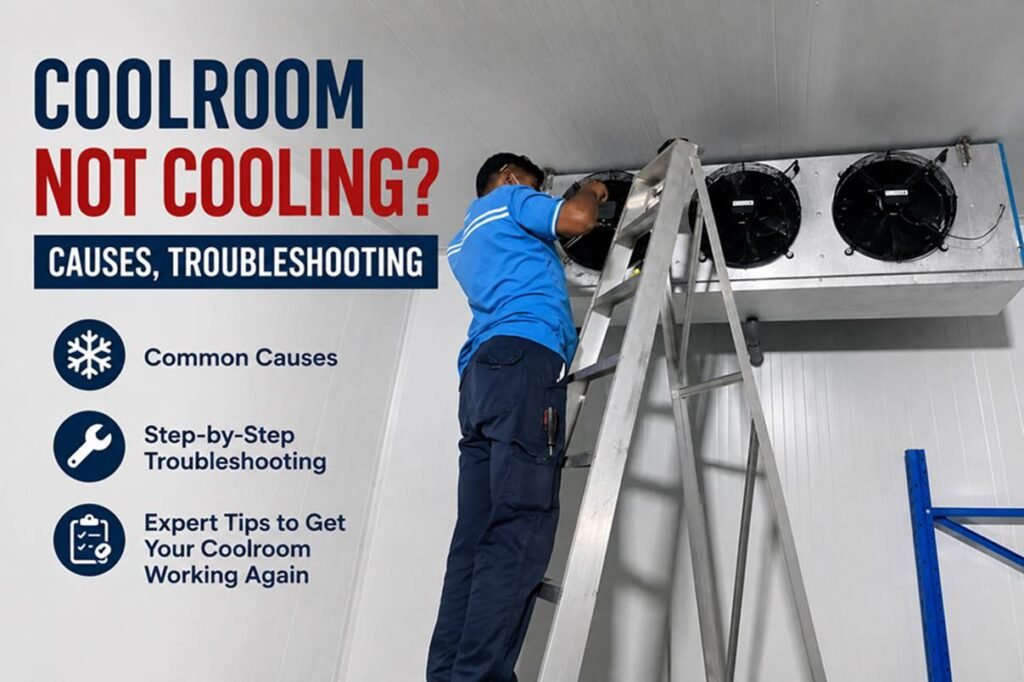
A coolroom that stops cooling is more than an inconvenience. For cafes, restaurants, butchers, and grocers, it puts thousands of dollars of stock at risk and threatens food safety compliance. Under HACCP guidelines, chilled food needs to stay at 5°C or below, and every hour above that temperature shortens the safe life of your product.
The good news is that not every cooling problem means a major repair. Some causes are simple things you can check and fix yourself in five minutes. Others involve refrigerant, electrical components, or the compressor, and those need a licensed technician.
Before you start: Be clear about what "not cooling" means in your case. Is the coolroom not reaching its setpoint at all? Is it cooling slowly? Or are some sections warm while others are cold? Each pattern points to different causes.
Quick Checks Before You Panic (5-Minute Owner Checklist)
Run through these before calling anyone. They resolve a surprising number of service callouts on the spot:
- 1 Is the unit actually running? Check the power supply, circuit breaker, and the isolator switch near the condensing unit. Cleaners and staff sometimes switch isolators off by accident.
- 2 Has the thermostat or controller setpoint been changed? A bumped dial or accidental button press can raise the setpoint. Confirm it is set where it should be—usually between 1°C and 4°C for chilled storage.
- 3 Is the door closing properly? A door left ajar or a worn coolroom door seal lets warm air pour in continuously. Check that the door swings shut fully and the seal grips all the way around.
- 4 Did you just load a large amount of warm stock? A coolroom pulling down a full delivery of room-temperature product will run warm for a while. Give it a few hours before assuming there is a fault.
- 5 Is airflow blocked inside? Stock stacked directly against the evaporator unit or blocking the air outlets stops cold air from circulating. Keep clear space around the evaporator and never stack product to the ceiling in front of it.
Common Causes of a Coolroom Not Cooling
1. Dirty or Blocked Condenser Coil
This is the single most common cause we see, especially in commercial kitchens. The condenser coil rejects heat from the system, and when it clogs with dust, grease, and lint, the coolroom cannot dump that heat anywhere. The system runs longer, works harder, and struggles to reach temperature. In hot weather, it may give up entirely.
2. Iced-Up Evaporator Coil
The evaporator inside the coolroom absorbs heat from the air. When it ices over, that ice acts as an insulating blanket, and airflow through the coil collapses. Icing is usually a symptom of something else: a failed defrost heater, a faulty defrost timer or controller, low refrigerant, or airflow problems.
3. Refrigerant Leak or Low Gas
Refrigerant does not get used up. If the system is low on gas, it has a leak. Telltale signs include a faint hissing sound, oily residue around pipe joints, ice forming on the suction line, and a compressor that runs constantly without reaching temperature. If you suspect a leak, learn more about our certified coolroom regas and leak repair services.
4. Failed Evaporator or Condenser Fan Motor
Fans move air across the coils. If a fan motor fails, the coil cannot do its job even if the compressor is running perfectly. A dead evaporator fan means cold is not circulated into the room. A dead condenser fan means heat is not rejected, causing the compressor to trip on high pressure.
5. Compressor Problems
The compressor is the heart of the system. Coolroom compressor faults show up in a few ways: the compressor runs but does not pump properly, it short cycles by starting and stopping every minute or two, or it does not start at all and may just hum and click.
6. Faulty Thermostat, Controller, or Temperature Sensor
The controller only acts on the information it receives. A drifting or failed temperature sensor can tell the controller the room is cold when it is not, so the system shuts off early. Digital controllers usually display error codes (like E1 or P1) when a sensor fails.
7. Damaged Panels or Insulation Breakdown
Coolroom panels are insulated sandwiches, and in older rooms, that insulation can break down if moisture penetrates through damaged joints or punctures. Warning signs include condensation forming on the outside of panels and soft or bulging sections.
8. Undersized or Overloaded System
Sometimes nothing is broken. If your business has grown and the coolroom now holds far more stock than it was designed for, or a heatwave has pushed ambient temperatures well beyond design conditions, the system may simply be at its limit.
How to Diagnose: Symptom to Likely Cause
| Symptom | Most Likely Causes |
|---|---|
| Runs constantly, never reaches temperature | Dirty condenser, low refrigerant, undersized system |
| Cools down, then warms up in cycles | Defrost fault, iced evaporator coil, faulty sensor |
| Not running at all | Power supply, tripped breaker, controller fault, failed compressor |
| Warm near the door only | Door seal failure, frequent door openings |
| Cold at the bottom, warm at the top | Evaporator fan failure, blocked airflow, overstacked stock |
| Ice visible on evaporator or pipes | Defrost failure, low gas, door seal leak |
| Compressor clicks or hums but will not start | Start components, capacitor, or compressor fault |
What You Can Fix Yourself vs What Needs a Technician
Safe for Owners & Staff
- Checking and correcting controller setpoint
- Gently cleaning light dust from condenser fins
- Clearing airflow around the evaporator
- Testing door seals and adjusting door closers
- Managing stock loading to prevent airflow blockage
Technician Only
- Any refrigerant work (requires an ARCtick licence)
- Electrical fault finding and wiring repairs
- Compressor, fan motor, or sensor replacement
- Defrost system component repairs
How Much Does Coolroom Cooling Repair Cost in Australia?
Costs vary depending on the specific fault and room size, but these standard industry ranges give a realistic picture:
Often credited towards repair labor costs upon booking.
Depending on door dimensions and gasket profile.
Covers replacement fan motor assembly and parts.
Includes leak locating, repair, pressure test, and gas charge.
Preventing Cooling Problems (Maintenance Tips)
- Clean the condenser coil quarterly (or monthly in greasy kitchen environments).
- Check door seals monthly with a paper slide test and replace split gaskets quickly.
- Watch the defrost cycle occasionally to confirm the evaporator is clearing fully.
- Keep stock clear of the evaporator and never block air discharge paths.
- Log temperatures daily. A slow upward drift over weeks is your earliest warning of a developing fault.
Frequently Asked Questions
Why is my coolroom running but not cold?
The most common reasons are a dirty condenser coil, low refrigerant from a leak, an iced-up evaporator, or a failed fan motor. The system is working, but it either cannot absorb heat from the room or cannot reject it outside.
How long should a coolroom take to get down to temperature?
An empty coolroom in good condition should pull down to setpoint within 2 to 4 hours of being switched on. A fully stocked room recovering after a delivery of warm product can take longer.
What temperature should a coolroom be in Australia?
For chilled food storage, food safety standards require 5°C or below, and most coolrooms are set between 1°C and 4°C to give a safety margin. Freezer rooms should hold -18°C or colder.
Can I regas my own coolroom?
No. In Australia, handling refrigerant requires an ARCtick licence, and doing it without one is illegal. Additionally, low gas always indicates a leak that must be repaired before recharging.
Why is my coolroom cold at the bottom but warm at the top?
Cold air sinks, so a warm upper section usually means air is not being circulated properly. The likely culprits are a failed evaporator fan, stock stacked too high, or an evaporator partially blocked with ice.
Coolroom Still Not Cooling?
If you've run through the 5-minute checklist and your room is still warm, gas or electrical work requires a licensed technician. Master Fridge Repairs provides rapid coolroom repairs across Sydney with ARCtick certified technicians and a 12-month warranty on parts.