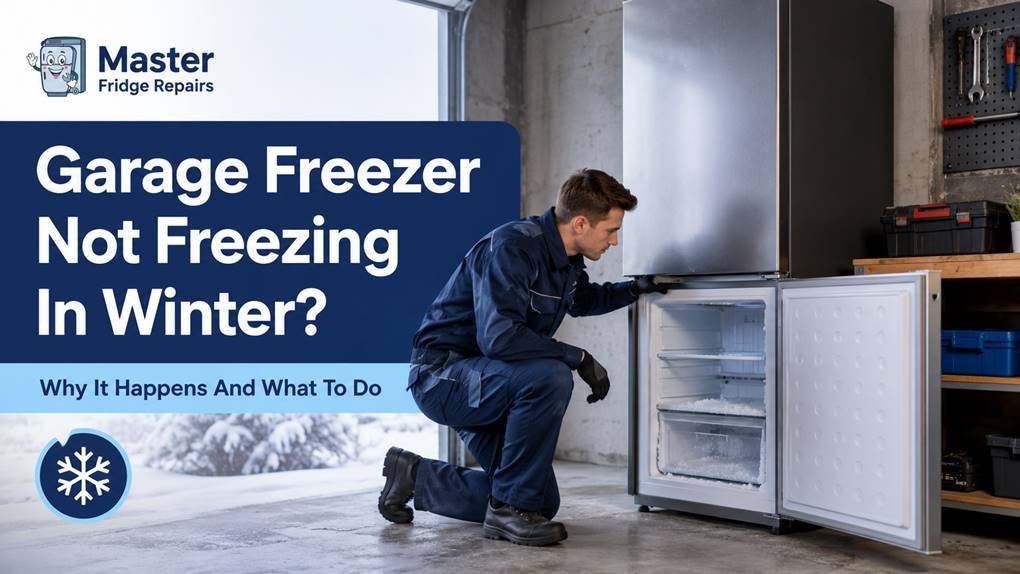
A garage fridge and freezer combo can be useful for extra food storage, drinks, frozen meals, and overflow from the kitchen. But in winter, many homeowners notice a strange problem: the fridge section feels cold, but the freezer stops freezing properly.
Food starts softening, ice cream melts, frozen items thaw, and the appliance may seem like it is barely running. In many cases, this does not mean the freezer has suddenly failed. It may be caused by the cold garage temperature affecting how the appliance controls the compressor.
In this guide, Master Fridge Repairs explains why a garage freezer may stop freezing in winter, what you can safely check, when a garage-ready fridge may be needed, and when to call a fridge technician.
If your garage fridge or freezer is not cooling, not freezing, leaking water, icing up, or making unusual noises, call 0401 065 051 for fridge repairs near you in Sydney.
Why Does A Garage Freezer Stop Freezing In Winter?
A standard refrigerator is usually designed to operate inside a home, where room temperature stays within a more stable range. When the appliance is moved into a cold garage, shed, outbuilding, or unheated storage area, the cooling system may not behave the same way.
In many dual-compartment units, the thermostat or temperature sensor is located in the fridge section. When the garage becomes cold, the fridge compartment may already feel cold enough, so the thermostat does not call for cooling. As a result, the compressor runs less often.
The freezer section relies on compressor runtime to stay frozen. If the compressor does not run long enough, the freezer can slowly warm up, even though the fridge section still feels cold.
This is why many people experience the confusing situation where:
- The garage fridge seems cold
- The freezer is not freezing
- Frozen food starts thawing
- The compressor does not run often
- The appliance works better when the weather warms up
This issue is especially common with standard fridges that are not designed for cold ambient garage conditions.
Fridge Works But Freezer Is Thawing
One of the most common signs of cold-weather garage fridge failure is when the fridge section appears normal but the freezer section stops holding temperature.
This can happen because the fridge and freezer compartments are connected through the same cooling system. The appliance may use one compressor and rely on airflow, dampers, sensors, and thermostat control to manage both compartments.
When the fridge compartment is cold enough due to the garage temperature, the unit may not run the compressor for long enough to keep the freezer properly frozen.
Common symptoms include:
- Freezer food becoming soft
- Ice cream melting
- Ice cubes shrinking or turning watery
- Freezer temperature rising overnight
- Compressor not running often
- Fridge section feeling cold but freezer not freezing
- The setup working again when moved indoors or when weather warms up
This problem can look like a thermostat fault, compressor issue, sensor failure, or refrigerant problem, so proper diagnosis is important before replacing parts.
Is The Thermostat Broken Or Is The Garage Too Cold?
A freezer not freezing in winter does not always mean the thermostat is broken. Sometimes the appliance is responding to the cold room temperature exactly as it was designed to.
However, a thermostat, sensor, defrost system, fan motor, compressor relay, or control board can still fail at the same time. That is why it is important to separate an environmental issue from a mechanical or electrical fault.
The garage may be too cold if:
- The freezer only stops freezing during winter
- The appliance works normally in warmer weather
- The garage is unheated or poorly insulated
- The compressor does not cycle often
- The fridge section feels cold enough but the freezer thaws
A repair fault may be more likely if:
- The freezer does not freeze in any season
- The compressor runs constantly but the unit stays warm
- The fridge is making loud buzzing, clicking, or grinding noises
- There is heavy frost on the back wall
- The appliance is leaking water
- The fridge trips power
- The fan is not running
- The fridge has an error code or control fault
Master Fridge Repairs can test the thermostat, compressor, fans, sensors, defrost system, door seals, airflow, and operating environment to confirm the real cause.
What Temperature Is Too Cold For A Garage Freezer?
There is no single answer for every fridge or freezer because the correct operating temperature range depends on the model, design, and manufacturer rating.
Some appliances are designed only for normal indoor conditions. Others are labelled as garage-ready or built for a wider temperature range. Some standalone freezers can handle colder ambient conditions better than standard dual-compartment models.
The safest step is to check the user manual or model plate information for the appliance's recommended ambient operating range.
As a general guide:
- Standard indoor fridges may struggle in cold garages
- Garage-ready fridges are designed for wider temperature changes
- Standalone chest freezers or upright freezers may perform better in garages
- Outdoor-rated and garage-rated appliances are usually better suited to unheated areas
- If the garage drops below the appliance's rated range, cooling performance can become unreliable
If you are not sure whether your unit is suitable for garage use, a technician can inspect the model and advise whether the issue is likely environmental or repair-related.
How To Keep A Garage Fridge Freezer Working In Winter
There are a few safe checks you can do before booking a repair.
1. Check The Appliance Manual
Look for the recommended ambient temperature range. If the appliance is not rated for cold garage conditions, it may keep having the same problem every winter.
2. Use A Fridge And Freezer Thermometer
Do not rely only on how cold the cabinet feels. Place a thermometer inside the fridge and freezer sections so you can monitor the real temperature.
A freezer should stay cold enough to keep food properly frozen. If the temperature keeps rising, do not ignore it.
3. Check The Temperature Dial
Some people try turning the fridge and freezer controls to a colder setting during winter. This may help in some cases by encouraging the compressor to run longer, but it is not a permanent solution.
If you turn the dial colder, monitor both sections carefully. The fridge compartment may become too cold and freeze fresh food.
4. Do Not Block Internal Vents
Overloading the freezer or fridge can block airflow. Keep vents clear so cold air can move properly between compartments.
5. Check Door Seals
Damaged door seals allow warm, moist air to enter the cabinet. This can cause frost, condensation, temperature swings, and extra compressor strain.
6. Clean Condenser Coils
Dusty condenser coils can affect cooling performance, especially if the fridge also struggles during summer. Clean coils help the unit release heat properly.
7. Keep The Fridge In A More Stable Area
If possible, move the appliance away from extremely cold, draughty, damp, or exposed garage areas. A more stable environment can help the system operate more consistently.
8. Consider A Garage-Ready Appliance
If you regularly need frozen food storage in the garage, a garage-ready refrigerator or standalone freezer may be more reliable than a standard indoor model.
Should I Turn The Fridge And Freezer Dials To Max?
Turning the dials to a colder setting may help temporarily in some garage configurations, but it is not a guaranteed fix.
The idea is simple: a colder setting may cause the compressor to run longer, which can help push more cooling into the freezer section. However, this depends on the fridge design and the actual garage temperature.
Be careful because setting the controls too cold can also cause:
- Fresh food freezing in the fridge section
- Higher energy use
- Extra compressor workload
- Temperature imbalance
- Frost build-up
Use this as a short-term troubleshooting step only. If the freezer keeps thawing, the fridge needs proper diagnosis or may not be suitable for garage use.
What Is A Garage Refrigerator Heater Kit?
A garage refrigerator heater kit is a manufacturer-approved part designed for some refrigerators used in cold environments. It usually adds a small amount of warmth near the thermostat area so the fridge thinks the room is warmer and allows the compressor to run more normally.
This can help some compatible top-mount models work better in colder garage conditions.
However, it is important to be careful:
- Not every fridge is compatible with a heater kit
- Heater kits should be manufacturer-approved
- Electrical parts should be installed safely
- A heater kit will not fix every cooling fault
- It may not be suitable for all brands or models
- It may not be the best option if the fridge has other faults
Do not install random heating devices inside or around a fridge. Unsafe modifications can create electrical, fire, or appliance damage risks.
If you are considering a garage kit, check the appliance manual or speak with a qualified technician first.
Should I Unplug My Garage Refrigerator In Winter?
It depends on whether you are using it and whether it contains food.
If your garage fridge contains food, do not unplug it without moving the food somewhere safe first. A freezer that is already struggling can thaw stock quickly, and unplugging it will make food spoilage more likely.
If the appliance is empty and you do not need it during winter, unplugging it may be fine, but prepare it properly:
- Remove all food
- Clean the fridge and freezer compartments
- Dry the interior fully
- Leave the doors slightly open
- Prevent mould and stale smells
- Keep the appliance in a safe, dry position
If you plan to start using it again later, check that it cools correctly before restocking it with food.
Garage-Ready Refrigerator Vs Standard Fridge
A standard refrigerator is usually designed for indoor use. It may not perform properly in a cold garage because the thermostat, compressor cycle, refrigerant behaviour, and airflow system are all designed around normal indoor temperatures.
A garage-ready refrigerator is designed to handle wider temperature changes. Depending on the model, it may use improved controls, insulation, heaters, or temperature management systems to keep the fridge and freezer working more reliably in garage conditions.
A standalone chest freezer or upright freezer may also be a better choice if your main goal is frozen storage. Dedicated freezers do not always rely on a fridge compartment thermostat in the same way as traditional combined units.
Before buying or installing a fridge in the garage, check:
- Whether it is rated for garage use
- The minimum ambient operating temperature
- The maximum ambient operating temperature
- Whether it needs rear, side, or front ventilation
- Whether it is suitable for unheated spaces
- Whether it is outdoor-rated, indoor-only, or garage-ready
Conversely, common causes for garage fridge failure during summer heat include:
- High ambient temperature
- Poor ventilation
- Dirty condenser coils
- Compressor overheating
- Fan motor failure
- Door seals leaking warm air
- Overloaded freezer compartments
- Appliance installed too close to walls or cabinetry
If your garage appliance fails in both winter and summer, it may be unsuitable for the garage environment or may have an underlying mechanical fault.
When It Is More Than A Cold Garage Problem
Sometimes a garage unit stops freezing because of a real repair fault, not just cold weather.
You should arrange a fridge technician if:
- The freezer does not recover when the weather warms up
- The fridge is running but not cooling
- The compressor is clicking or buzzing
- The fan is noisy or not running
- There is heavy ice build-up inside the freezer
- Water is leaking inside or under the unit
- The fridge trips power
- Door seals are damaged
- The appliance has an error code
- Food keeps spoiling or thawing
Master Fridge Repairs can inspect the appliance and identify whether the issue is caused by the garage environment, thermostat, compressor, sensor, fan motor, defrost system, door seal, blocked airflow, or another cooling fault.
Can Master Fridge Repairs Help With Garage Fridge and Freezer Problems?
Yes. Master Fridge Repairs provides fridge repairs and freezer fault diagnosis across Sydney for homes and businesses.
Our technicians can check:
- Fridge and freezer temperatures
- Thermostat operation
- Temperature sensor response
- Compressor performance
- Evaporator fan operation
- Condenser fan operation
- Defrost system function
- Door seal condition
- Drainage issues
- Airflow restrictions
- Installation environment
- Garage or outbuilding suitability
If your appliance is not worth repairing, we will give honest advice so you can decide whether a repair, relocation, garage-ready appliance, or standalone freezer is the better option.
Book Fridge Repairs Near You In Sydney
If your garage fridge or freezer is not freezing in winter, do not assume the compressor has failed straight away. The issue may be caused by cold ambient temperature, thermostat behaviour, poor airflow, worn seals, or a repair fault that needs testing.
Master Fridge Repairs provides reliable fridge repairs near you across Sydney, with same-day service available in many areas.
Call 0401 065 051 today to book a fridge technician or request a free quote.
Frequently Asked Questions
A garage freezer can stop freezing in winter when the surrounding temperature becomes too cold for the unit to operate correctly. In many standard fridges, the thermostat is controlled by the fridge section. If the garage is cold, the fridge may not call for cooling, so the compressor runs less and the freezer can warm up.
Check the appliance manual, monitor temperatures with a fridge thermometer, avoid blocking vents, keep door seals in good condition, clean condenser coils, and place the unit in a more stable area if possible. If the fridge is not rated for garage use, consider a garage-ready model or ask a technician whether a manufacturer-approved garage kit is suitable.
Some garage-ready freezers are designed to work in colder ambient temperatures, but many standard models are not. If the temperature drops below the appliance's rated operating range, the freezer may stop holding temperature properly. Always check the manufacturer's operating range for your exact model.
The answer depends on the appliance model. Standard indoor appliances may struggle in cold garages, while some garage-ready freezers are designed for wider temperature ranges. Check the user manual or model specifications. If food is thawing, the environment may be too cold for that appliance or the unit may have a repair fault.
Only unplug it if it is empty and not needed. Remove all food, clean and dry the interior, and leave the doors slightly open to prevent mould and smells. If the appliance contains food, unplugging it can cause spoilage.
It may help temporarily in some cases by making the compressor run longer, but it is not a guaranteed fix. It can also make the fridge section too cold and freeze fresh food. If the freezer keeps thawing, the appliance needs proper diagnosis.
A garage refrigerator heater kit is a manufacturer-approved part used on some compatible models to help the thermostat call for cooling in cold conditions. It is not suitable for every fridge and should not be treated as a universal DIY fix.
If you mainly need frozen storage, a standalone chest freezer or upright freezer rated for garage use may be more reliable than a standard combined unit. Always check the temperature rating and installation requirements before buying.
Summer garage freezer problems are usually caused by heat, poor ventilation, dirty condenser coils, fan faults, worn door seals, overloaded storage, or compressor strain. This is different from winter issues, where cold ambient temperature can stop the compressor from running enough.
Call a technician if the freezer keeps thawing, the fridge does not recover in warmer weather, the compressor is noisy, the fan is not working, there is ice build-up, water is leaking, the fridge trips power, or food keeps spoiling. Master Fridge Repairs can inspect the appliance and advise whether repair is worthwhile.